Over the past eight years, at Soamee we have delivered more than 150 software projects. From MVPs for seed-stage startups to enterprise platforms operating across dozens of markets. And throughout all that time, one question has come up repeatedly in every kickoff, every retrospective, every conversation with a new client: how do we know the software we build is truly good?
It’s not a trivial question. The software industry lacks a universal quality standard. We don’t have the equivalent of a Michelin star, a straightforward ISO certification, or an appellation of origin seal. What we have are partial metrics: test coverage, sprint velocity, Lighthouse scores, uptime ratios. Each useful in its context, but none capable of offering a complete picture.
Today we present our answer to that problem: the Soamee Artisan Index.
What is the Artisan Index?
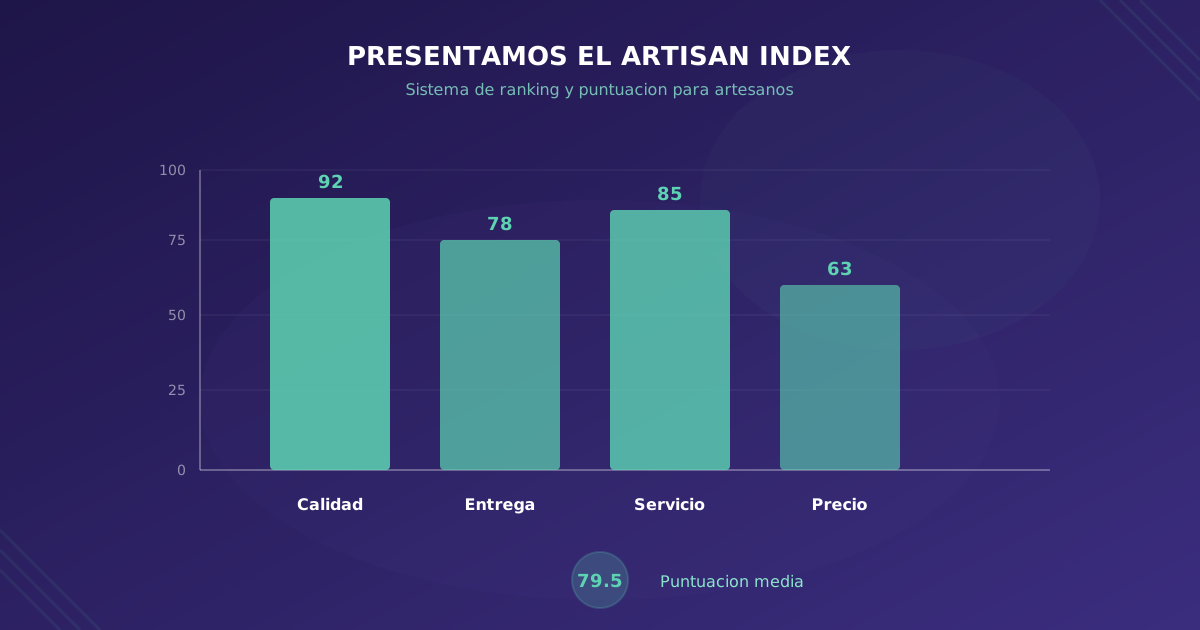
The Artisan Index is a multidimensional evaluation framework that analyzes software quality from 7 complementary perspectives. Each dimension is scored from 0 to 100, and the final score is a weighted average that reflects both technical excellence and real business impact.
It’s not a theoretical exercise. We apply it internally to every project we deliver and use it as a continuous improvement tool. We’re sharing it publicly now because we believe the conversation about software quality needs a new vocabulary — richer and more honest than “it works” or “it doesn’t work.”
The 7 Dimensions
1. Craftsmanship
The foundation of everything. We evaluate the intrinsic quality of the code: adherence to design patterns, naming convention consistency, cyclomatic complexity, tech debt ratio. We use tools like SonarQube and ESLint with strict rules, plus peer code reviews with standardized rubrics.
A Craftsmanship score of 90+ means any senior developer can open the repository, understand the architecture, and start contributing without needing a walkthrough session.
2. Performance
We don’t just run Lighthouse in lab mode. We measure Core Web Vitals under real conditions, API response times under load, JavaScript bundle size, SSR efficiency, and behavior on devices with slow connections.
The difference between a Performance score of 60 and 90 is the difference between a user who waits and a user who converts.
3. Resilience
How does the software behave when things go wrong? We evaluate circuit breakers, retry systems, message queues, health checks, and graceful degradation mechanisms. We measure MTTR (Mean Time To Recovery), error rates, and actual uptime over the last 12 months.
Software with a Resilience score of 95+ can lose a database and still serve cached responses to the end user while recovering.
4. Adaptability
How much does it cost to add a new feature? How long does a new developer need to become productive? We measure module coupling, technical documentation coverage, the existence of well-defined internal APIs, and ease of extension.
Adaptability is what differentiates a project that evolves with agility from one that becomes an immovable monolith.
5. Security
We evaluate OWASP Top 10 compliance, dependency audit frequency, data protection policy implementation, HTTP security headers, SAST/DAST analysis usage, and penetration testing results.
In regulated projects (fintech, healthtech, legaltech), this dimension may carry additional weight in the final evaluation.
6. User Experience
It’s not enough for it to work: it needs to be a pleasure to use. We evaluate WCAG 2.1 AA compliance, design system consistency, real user testing results, error message quality, and main flow fluidity.
A UX score of 90+ means 95% of users complete their tasks without friction.
7. Business Impact
This dimension carries double weight in the final formula, and for good reason. We measure real conversion improvement, time-to-market reduction, successful deployment frequency, documented ROI, and alignment with the client’s business KPIs.
Software can be technically perfect, but if it doesn’t generate value for the business, it cannot be considered artisan.
The Formula
The final Artisan Index score is calculated as follows:
AI = (C + P + R + A + S + UX + 2 x BI) / 8
Where each letter represents the score (0-100) of the corresponding dimension. Business Impact is multiplied by 2 before averaging, reflecting our conviction that software exists, above all, to generate results.
The Benchmarks
We have defined four reference levels:
- 0-40: Legacy — Software with significant tech debt, no tests, difficult to maintain.
- 40-60: Standard — Functional but with clear areas for improvement in performance or security.
- 60-80: Professional — Good practices applied, active monitoring, committed team.
- 80-100: Artisan — Excellence across all dimensions. Software crafted with mastery.
Our internal projects always aim for the Artisan level. Not all of them reach it on the first iteration (an MVP, for example, can be perfectly valid with a Standard score), but the Artisan Index gives us a clear roadmap of where to evolve.
Why We’re Sharing This
We believe the software industry needs better tools to talk about quality. Not to create hierarchies or criticize others’ work, but to establish a common language between engineers and business stakeholders.
The Artisan Index doesn’t claim to be the only valid framework. It’s ours, born from our experience, our mistakes, and our convictions. If you find it useful, adapt it. If you want to discuss it, we’re open to the conversation. And if you want to know what score your current software would get, the first audit is free.