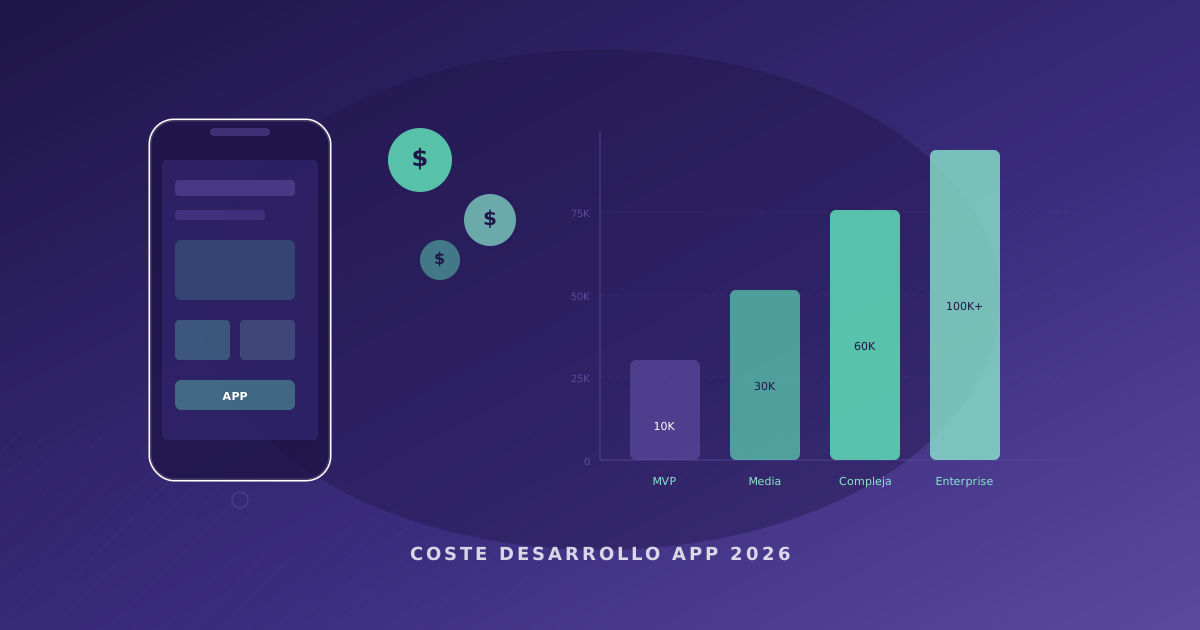
It is the question we receive at least three times a week: “how much does it cost to develop an app.” The honest answer is “it depends,” but that does not help anyone. In this article we break down the real costs we handle in 2026, based on dozens of projects executed over the last two years.
Price Ranges by Complexity
Let us start with concrete numbers. These ranges reflect European market prices for professional development:
Simple App (MVP / Idea Validation)
Range: 15,000 - 35,000 EUR
Typical features:
- 5-10 screens
- Basic authentication (email/password, Google, Apple)
- Simple CRUD (create, read, update, delete records)
- Integration with 1-2 external APIs
- Basic push notifications
- Minimal admin panel
Examples: Booking app for a restaurant, professional directory, internal feedback app for a company.
Estimated timeline: 6-10 weeks
Medium Complexity App
Range: 35,000 - 80,000 EUR
Typical features:
- 15-25 screens
- Payment system (Stripe, bank gateway)
- Real-time chat
- Geolocation and maps
- Role and permission system
- Integration with multiple APIs
- Analytics and business dashboards
- Basic offline support
Examples: Services marketplace, local delivery app, team management platform, health tracking app.
Estimated timeline: 12-20 weeks
Complex App
Range: 80,000 - 200,000+ EUR
Typical features:
- 30+ screens with complex flows
- Real-time video/audio processing
- Integrated artificial intelligence (recommendations, computer vision)
- Robust offline synchronization
- Multi-language and multi-region
- Regulatory compliance (GDPR, PSD2, healthcare)
- Enterprise integrations (SAP, Salesforce, ERPs)
- Scalability for thousands of concurrent users
Examples: Telemedicine platform, fintech app, vertical social network, logistics system with real-time tracking.
Estimated timeline: 20-40+ weeks
Factors That Determine the Price
1. Platform: Native vs Cross-Platform
In 2026, the native vs cross-platform debate is largely resolved for most cases:
| Approach | Relative Cost | Best For |
|---|---|---|
| React Native | 1x (reference) | Most B2C and B2B apps |
| Flutter | 1x | Apps with highly customized UI, startups |
| iOS + Android native | 1.6-1.8x | Apps with extreme performance requirements, specific hardware |
| Kotlin Multiplatform | 1.2x | Teams with Android/Kotlin background |
Our recommendation: For 80% of projects, React Native with Expo offers the best balance between cost, development speed, and performance. The ecosystem has matured enormously and with the new architecture (Fabric + TurboModules) the performance differences from native are minimal.
2. UX/UI Design
Design can represent between 15% and 25% of the total budget:
- Basic design (standard components, no complex animations): 3,000-8,000 EUR
- Intermediate design (custom visual identity, micro-interactions): 8,000-20,000 EUR
- Premium design (motion design, custom illustrations, advanced prototyping): 20,000-40,000 EUR
Do not cut corners here. Good design reduces development costs (fewer iterations), increases user retention, and reduces support tickets.
3. Backend and Infrastructure
The backend is the iceberg beneath the surface. Options in 2026:
Backend-as-a-Service (BaaS)
- Supabase: Ideal for MVPs and medium apps. PostgreSQL database, authentication, storage, realtime. Cost: 0-300 EUR/month.
- Firebase: Good option if you are already in the Google ecosystem. Variable cost based on usage.
- AWS Amplify: For projects that need to scale on AWS.
Custom Backend
- Necessary when business logic is complex or there are compliance requirements
- Adds 30-50% to the total project cost
- Typical technologies: Node.js + TypeScript, Python + FastAPI, Go
4. Third-Party Integrations
Each integration has a development cost and a recurring cost:
| Integration | Development Cost | Typical Monthly Cost |
|---|---|---|
| Payment gateway (Stripe) | 2,000-5,000 EUR | 0 + commissions |
| Real-time chat | 3,000-8,000 EUR | 0-200 EUR |
| Push notifications | 1,000-3,000 EUR | 0-100 EUR |
| Analytics (Mixpanel, Amplitude) | 1,000-2,000 EUR | 0-500 EUR |
| Social authentication | 1,000-2,000 EUR | 0 |
| Maps / geolocation | 2,000-5,000 EUR | 0-200 EUR |
| AI / ML (OpenAI, custom) | 5,000-20,000 EUR | Variable |
Hidden Costs Nobody Tells You About
App Store Publishing
- Apple Developer Program: 99 USD/year
- Google Play Console: 25 USD (one-time payment)
- Review and approval: Can take 1-7 days. If rejected (and it happens more than you think), each iteration adds 2-5 additional days
Post-Launch Maintenance
Golden rule: budget 15-20% of the annual development cost for maintenance. This includes:
- Security updates and dependency updates
- Adaptation to new iOS and Android versions (every September/October)
- Bug fixes reported by users
- Monitoring and DevOps
Testing on Real Devices
The simulator is not enough. You need to test on physical devices:
- BrowserStack / AWS Device Farm: 200-400 EUR/month during development
- Physical QA devices: 500-2,000 EUR in hardware
Legal Compliance
- Privacy policy and terms of use: 500-2,000 EUR (specialized lawyer)
- GDPR compliance: 2,000-5,000 EUR if you handle EU user data
- Accessibility (WCAG): 3,000-8,000 EUR to comply with European 2025 regulations
User Acquisition Costs
Having the app published does not mean having users. Budget for:
- ASO (App Store Optimization): 500-2,000 EUR/month
- Launch marketing: 5,000-20,000 EUR
- Cost per install (CPI): 1-5 EUR in Europe depending on the sector
How to Optimize Your Budget
Strategy 1: MVP First, Always
Do not build the complete app all at once. Identify the 3-5 features that validate your business hypothesis and launch with that. Iterating on real data is infinitely more efficient than iterating on assumptions.
Version 1 (MVP): 20,000 EUR → Validate with 100 users
Version 2 (iteration): 15,000 EUR → Add features based on feedback
Version 3 (scale): 25,000 EUR → Optimize performance and grow

Total: 60,000 EUR with real validation at every step
vs
"Complete app" without validation: 80,000 EUR with high pivot risk
Strategy 2: Use Open Source Components
In 2026, there are mature libraries for almost everything:
- UI: Tamagui, NativeWind, React Native Paper
- Navigation: React Navigation, Expo Router
- State: Zustand, TanStack Query
- Forms: React Hook Form + Zod
- Animations: Reanimated 3, Moti
Each well-chosen library saves you weeks of custom development.
Strategy 3: Negotiate a Hybrid Model
Instead of fixed price (risk for the agency) or pure time & materials (risk for you), negotiate a hybrid model:
- Discovery phase: Fixed price (2-3 weeks, 5,000-10,000 EUR)
- MVP development: Fixed price based on defined scope
- Post-launch iterations: Time & materials with monthly cap
Strategy 4: Consider Total Cost of Ownership (TCO)
The development price is just the beginning. Calculate the 3-year TCO:
| Concept | Year 1 | Year 2 | Year 3 |
|---|---|---|---|
| Development | 40,000 | 15,000 | 15,000 |
| Infrastructure | 3,600 | 6,000 | 9,000 |
| Maintenance | 6,000 | 8,000 | 8,000 |
| Marketing | 15,000 | 10,000 | 10,000 |
| Legal/compliance | 3,000 | 1,000 | 1,000 |
| Total | 67,600 | 40,000 | 43,000 |
3-year TCO: ~150,000 EUR for a medium complexity app.
Differences Between Freelancer, Agency, and Internal Team
Freelancer
- Cost: 30-50% less than an agency
- Pros: Flexibility, direct relationship, no overhead
- Cons: Availability risk, hard to scale, single point of failure
- Ideal for: Simple MVPs, prototypes
Specialized Agency
- Cost: Reference price
- Pros: Multidisciplinary team, established processes, warranty, continuity
- Cons: Management overhead, potentially less flexibility
- Ideal for: Products going to production, companies needing ongoing support
Internal Team
- Cost: 40-60% more than an agency (salaries + recruiting + training + turnover)
- Pros: Domain knowledge, full dedication, fast iteration
- Cons: Ramp-up time, fixed cost even without projects
- Ideal for: Tech-first companies where the app is the business
Realistic Timeline by Project Type
Simple App (MVP)
| Phase | Duration | Deliverable |
|---|---|---|
| Discovery | 1-2 weeks | PRD, wireframes, estimate |
| UX/UI Design | 2-3 weeks | Mockups, interactive prototype |
| Frontend development | 3-4 weeks | Functional app |
| Backend + integrations | 2-3 weeks | API, database |
| Testing + QA | 1-2 weeks | Validated app |
| Publishing | 1 week | App in stores |
| Total | 10-15 weeks |
Medium Complexity App
| Phase | Duration |
|---|---|
| Discovery | 2-3 weeks |
| UX/UI Design | 3-5 weeks |
| Development (sprints) | 8-12 weeks |
| Testing + QA | 2-3 weeks |
| Closed beta | 2-3 weeks |
| Publishing + launch | 1-2 weeks |
| Total | 18-28 weeks |
What to Ask Before Hiring
Before signing with any provider, make sure you have clear answers to these questions:
- Who owns the source code? (It must be yours, always)
- What happens if the project is cancelled midway? (Exit clause)
- How are scope changes managed? (Documented change requests)
- What exactly does post-launch maintenance include?
- What tech stack do they recommend and why?
- Can they show similar apps in production?
- What is the QA process? (Automated testing, manual, devices)
- How are credentials and sensitive data managed?
Conclusions
Developing an app in 2026 is a significant but accessible investment if planned correctly. The key points:
- Start with an MVP of 15,000-35,000 EUR to validate before scaling
- Budget the TCO, not just the initial development
- Choose cross-platform (React Native or Flutter) unless you have very specific reasons for native
- Do not skimp on design - good UX reduces long-term costs
- Look for a technical partner, not just a vendor
At Soamee we work with a transparent model where we share the complete cost and timeline breakdown before starting. If you have an idea and want to know how much it would cost to make it a reality, let us talk.